
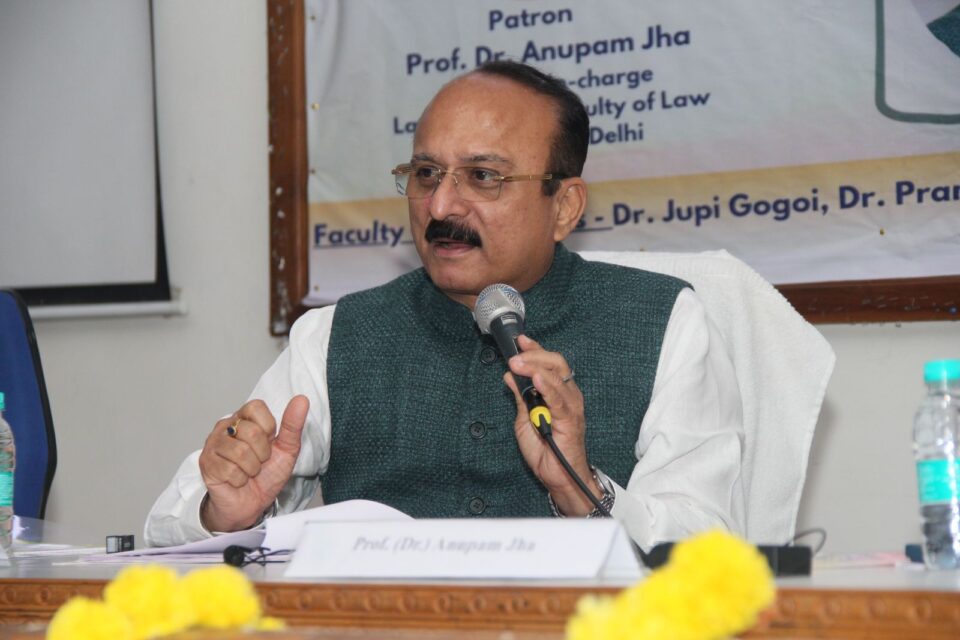
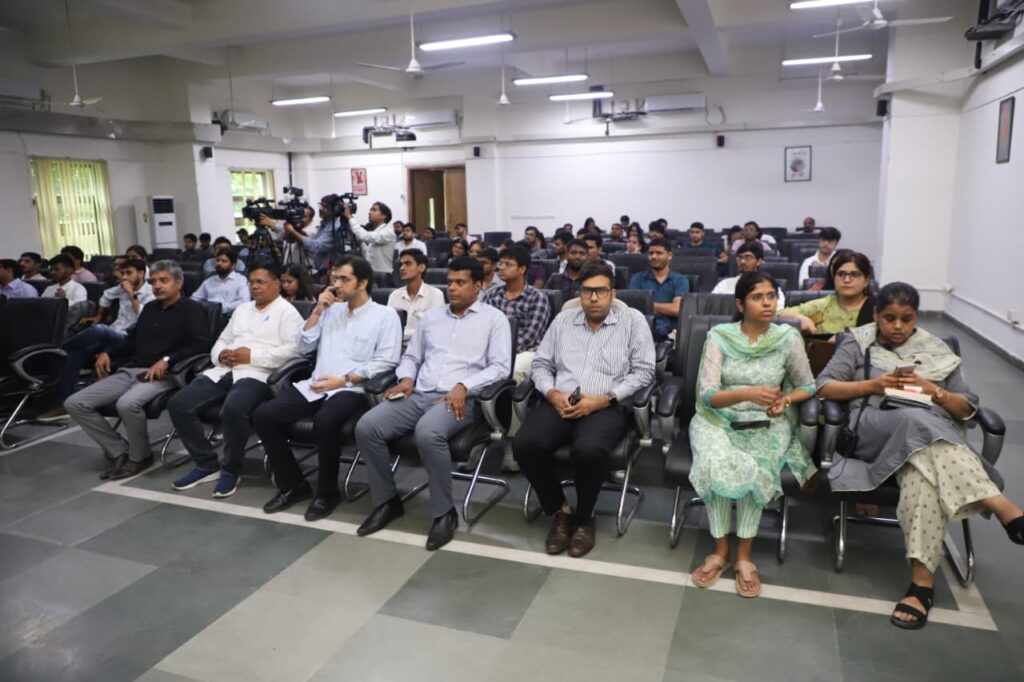
Delhi’s Education Minister Ashish Sood, today engaged in an interactive session with law students at Law Centre-II, University of Delhi, sharing detailed insights on the Delhi School Education (Transparency in Fixation and Regulation of Fees) Act -2025. Responding to questions from the students, the Minister explained how this newly enacted law serves the interests of Delhi’s citizens. He stated that the Delhi Government had introduced the Delhi Private School Fee Regulation Bill-2025 in the Assembly to curb arbitrary fee hikes by private schools which after approval has now become law.
The Minister said that Delhi University has always been a hub of social and political change. Owing to his deep association and commitment to the University, he chose to be present at Law Centre-II. Recalling his student days and his tenure as DUSU President, he shared with the students that whether it was the anti-Emergency movement or the fight against the Bofors scandal, all such movements began on this campus. Carrying forward that tradition, a historic reform in the education sector has now been implemented—a reform that earlier governments never undertook, which allowed arbitrary fee hikes by private schools to continue unchecked.
Referring to the Delhi School Education Act (DSEAR), 1973 Shri Sood pointed out that the law only covered about 300 private schools (those allotted land by DDA) under regulation. As a result, no action was taken against other schools. Over time, the number of private schools in Delhi has increased to about 1,700, where nearly 18 lakh children study. Yet only 300 schools were subject to regulation. Now, with the enactment of the Delhi School Education (Transparency in Fixation and Regulation of Fees) Act -2025, all 1,700 schools come under the purview of this law, not just those governed by the DDA land clause.
The Minister highlighted that previous governments failed to provide quality education in public schools, forcing parents to turn to private schools, where they faced arbitrary fee hikes, compulsory uniforms/books, and various unjust charges. Parents suffered mental, financial, and emotional stress due to such practices, often resorting to litigation in High Courts and even the Supreme Court such as the case of DPS Dwarka. He reiterated that the Delhi Government’s intent is to ensure that every child in the capital gets access to quality education without parents having to bear the unbearable burden of exorbitant fees. This law was drafted after wide consultations with education experts, parents, and stakeholders.
Three-tier fee regulation mechanism introduced under the new law. At the school level, a Fee Fixation Committee will be formed comprising the management, principal, three teachers, five parents (with mandatory SC/ST/women representation), and a representative from the Directorate of Education. In case of disagreement at this level, even a single parent can escalate the matter to the district-level committee. The final authority will rest with the State-level Appellate Committee, whose decisions will be binding on schools. All decisions will be made by consensus, not majority vote. Once fixed, the fee structure will remain valid for three years, ensuring financial and emotional stability for parents.
The Education Minister reiterated the three key objectives of the law- transparency in fee determination, empowered participation of parents, and veto power for parents on fee hikes. No school can arbitrarily raise fees. Schools will have to disclose detailed information regarding location, facilities, expenses, and quality of teaching before proposing fee changes. Shri Sood emphasized that this law safeguards the dreams of Delhi’s children, removing profiteering from education and building a new Delhi recognized not by empty slogans but by real reforms.
Explaining the penalty provisions, the Minister said that schools increasing fees without approval or exploiting students/parents can be fined between ₹50,000 to ₹2 lakh per student. Additionally, the penalty will double every 20 days of delay in compliance. Schools that refuse to comply with committee decisions may also face cancellation of their recognition/license. With mandatory parental participation, the entire fee regulation process will remain transparent.
Clarifying the intent of the law, the Minister stressed that the Government does not aim to control or harm private schools, but only to regulate arbitrary fee hikes. The goal is to protect the interests of students and parents while bringing equity to the education sector. He added that every provision of the law has been drafted with sensitivity and foresight, keeping parents’ welfare at the center. The Government’s approach is balanced neither creating anarchy for schools nor financial burden for parents. He also criticized the previous Aam Aadmi Party government, which boasted of an “education revolution” but stood exposed for corruption in the education sector.
Sood urged the students and faculty present to carefully study the new law and share their suggestions. He also appealed for widespread dissemination of the law in society so that it becomes even stronger with public participation.