
MAIN HIGHLIGTS

•   Delhi’s upcoming E-Waste Eco Park at Holambi Kalan to have double the originally planned capacity — 1,10,000 MT per annum — and double the area after Minister Sirsa’s visit and detailed study of Norway’s Revac facility (Aug 4–5).

•   Plant to operate a global zero-waste model, ensuring no pollution, no radiation, no water pollution and no environmental damage, with in-house water purification, concretised flooring, and advanced scrubber systems.

•   Segregation of waste including metals to follow global best practices — recovering aluminium, iron, and refuse-derived fuel, driving a true circular economy.

•   Robust third-party monitoring to be introduced for compliance, modeled after Norway’s non-profit inspection framework.
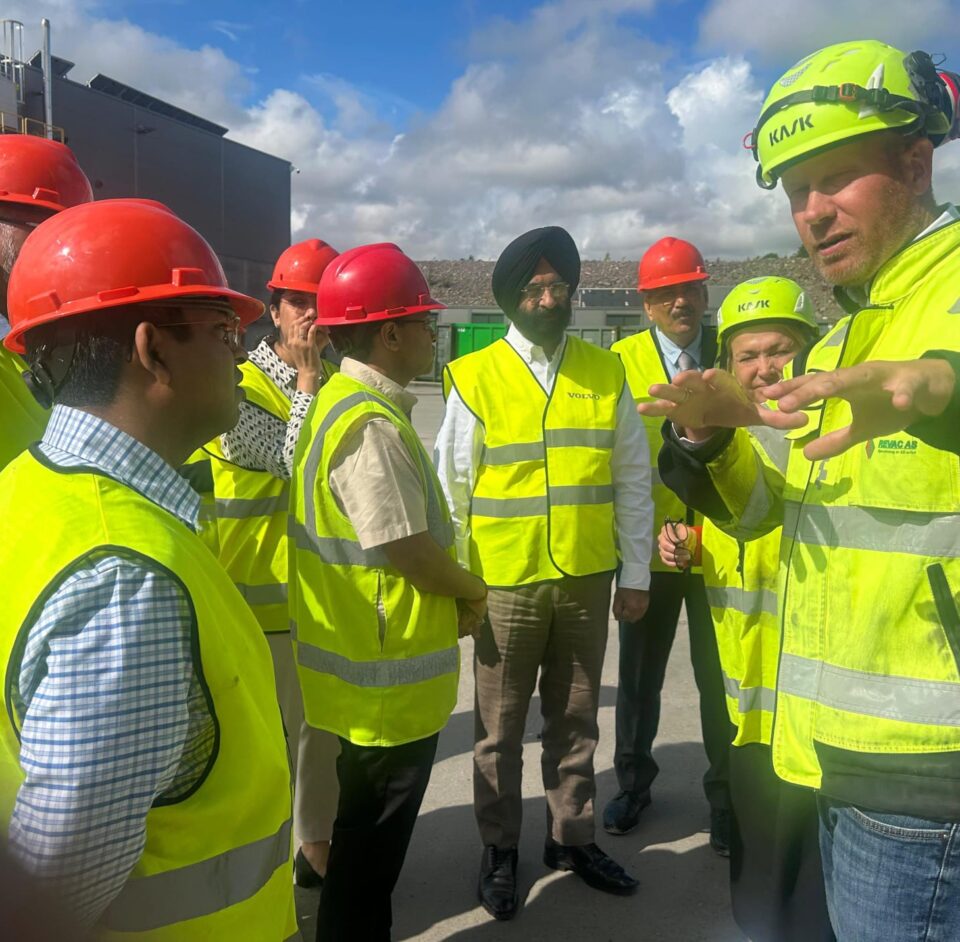
In a significant step towards establishing Delhi as a national leader in sustainable industrial development, Hon’ble Minister for Environment, Forest & Wildlife and Industries, Manjinder Singh Sirsa, visited and studied the internationally acclaimed Revac E-Waste Processing Facility, located at Haukeveien 11, 3174 Revetal, Norway.
The visit forms a key milestone in the Delhi Government’s plan to develop India’s first-of-its-kind E-Waste Eco Park at Holambi Kalan, which was initially to be built with an investment of ₹150 crore to process 51,000 metric tonnes of e-waste annually. However, after a detailed study of the Revac facility — selected as a global model due to its proven track record in eco-friendly e-waste management and geographical and operational similarity to the proposed Delhi site — the plans now to operate with enhanced capacity.
The new plant will be built with an operational capacity of 1,10,000 MT of waste annually, in almost double the area, and with nearly twice the original capital expenditure. It will also be based on the global zero-waste principle, ensuring no pollution, no radiation, no untreated discharge, and complete material recovery to feed a circular economy.
Spread over an area of 110,000 square meters, the Revac plant processes approximately 1,10,000 metric tonnes of e-waste per annum, making it one of the largest and most advanced facilities of its kind in Europe. Built on best environmental practices, the facility specialises in responsible recycling, material recovery, and pollution-free operations. Notably, Revac also exports finished recycled materials to Indian manufacturers, reinforcing a sustainable cross-border circular economy.
During his visit, the Minister undertook a detailed technical inspection of the facility’s infrastructure — from safe dismantling and segregation processes to advanced extraction of reusable materials and eco-conscious waste treatment systems. He also interacted with Revac’s senior engineers and operational heads to discuss technological adaptation, compliance, and community integration.
The second learning from the plant was the need for a robust inspection mechanism during e-waste processing. While in Norway this is done with the help of not-for-profit organisations engaged in the disbursement of Extended Producer Responsibility (EPR), in India, the Delhi government is now planning to engage an expert agency to do third-party monitoring.
The visit to the plant also dispelled several myths regarding supposed pollution from e-waste facilities. The plant in Norway had robust mechanisms to ensure there is zero pollution and no radiation — including concretising the entire floor, reusing water in the same tank with in-house water purification technologies, and installing a state-of-the-art scrubber. The plant does not burn waste; instead, it uses threshers and segregators to separate valuable items such as aluminium, iron, and refuse-derived fuel from discarded waste. Following this example, it has now been decided that the Holambi Kalan plant will adopt a similar model to achieve zero waste and avoid any environmental harm.
Sirsa affirmed Delhi’s commitment to balancing ecology with industry: “As both the Environment Minister and the Industries Minister of Delhi, I will not allow either to suffer because of the other. Our goal is integrated progress — where clean industry fuels economic growth and safeguards the environment.”
He further noted that the selection of Revac was deliberate, not just for its global credibility but also because its terrain and its commitment to processing e-waste without causing any environmental pollution.
The upcoming E-Waste Eco Park at Holambi Kalan will operate under a Public Private Partnership (PPP) model, facilitated by the Delhi State Industrial and Infrastructure Development Corporation (DSIIDC). Designed to accommodate many categories of e-waste as per the E-Waste Management Rules 2022, the park is expected to generate over ₹500 crores in revenue, create thousands of green jobs, and formalise the currently informal and hazardous e-waste sector.
India is currently the third-largest generator of e-waste globally, and Delhi accounts for nearly 9.5% of the national total. Recognising this urgent challenge, the Delhi Government is leading from the front under the broader mission of Viksit Bharat@2047, by investing in sustainable urban infrastructure that aligns economic opportunity with environmental responsibility.
“This is not just about e-waste,” said Sirsa, “it is about vision — of a Delhi that is clean, circular, competitive, and future-ready.”
